Several years ago, I went through a period of being utterly preoccupied with the subject of color; I just couldn’t read and look enough to satisfy my obsession. (I still love the subject, but am now able to think and read about other subjects, too.) I remember waiting with excitement for the next volume in Michel Pastoureau’s color series to be published in English. How many people pre-ordered Yellow, The History of a Color? From sheer love of color, I couldn’t resist writing something that became My Color Pilgrimage. But what should I do with this little “book?”—I worked so hard on it, but it’s quite odd. At last, I found a home for it! I’m releasing short essays with my favorite parts to my subscribers on Substack. I’ve been thrilled by people’s interest in My Color Pilgrimage, and take great satisfaction at finally being able to share my love of color with the world.
I agree with artist Paul Klee: “Colour has taken hold of me; no longer do I have to chase after it. I know that it has hold of me for ever.”
Onward,

![]()
5 Things Making Me Happy
I was absolutely flabbergasted, and deeply moved, to read this short account about a mysterious photo album that ultimately revealed the truth about a photographer who, with his wife, was determined to bear witness to what was happening in Paris. It’s an extraordinary story, with extraordinary photos. I hope a full documentary is on its way.
Recently, in her Substack newsletter, How to Be Brave, journalist Jenny Anderson wrote a poignant and thought-provoking piece, “Helping kids show up for the people they love, the dementia edition.” “They got us this far. Now we help them get to the end.” I have so many friends grappling with the sad challenge of having a parent with dementia.
One way to incorporate whimsy into everyday life is to celebrate minor holidays—and two good opportunities are coming up. St. Patrick’s Day is March 17, and it’s a very fun holiday to observe. I’ll never forget years ago, when I served on a jury, and several of my fellow jurors, the policeman who was testifying, and even the presiding judge wore green, and we were dismissed early in honor of the day. Also, Pi Day is March 14 (3.14). Fun fact: true to its spirit, MIT releases its college admissions decision on Pi Day each year, and frequently, the decisions are released at 6:28 pm ET, which is Tau time.
We’ve had a long, frigid winter here in New York City, and I’m thrilled that the weather is warmer and the days are longer. However, for many people, spring also means allergy season. The New York Times had a helpful article: “Allergy season is coming. These 4 steps can help you prepare”. I was surprised to learn that by taking certain medications two to four weeks before you’re likely to get symptoms, you can block the histamine that triggers itching, sneezing, and congestion.
In my book Better Than Before, I write about the 21 strategies we can use to make or break our habits. Twenty-one seems like a lot—but that’s good, because different strategies work at different times and for different people. It took me a long time to appreciate the great power of the Strategy of Clarity—especially for Questioners. Lack of clarity can cause paralysis, especially when values are in conflict. For instance:
- I want to give 110% to work. I want to give 110% to my family.
- I want to work on my novel. I want to exercise.
- I want to spend less time in the car. I want my children to participate in many after-school activities.
This week on Happier with Gretchen Rubin
PODCAST EPISODE: 577
How Well Do You Know Yourself? Plus Hacks for Staying Warm & Putting Down Your Phone
INTERVIEW
Nir Eyal
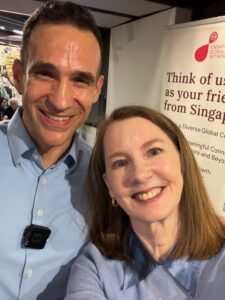
Nir Eyal, bestselling author of Hooked and Indistractable, is a leading thinker on behavior change and human potential. His new book, Beyond Belief, explores how our assumptions shape performance, motivation, and what we think is possible. Now through March 20, you can enter to win a free copy. I interviewed Nir about his new book in New York City on his publication date—we had a great conversation.
Q: Can you suggest something we might try to help ourselves to become happier, healthier, more productive, or more creative?
One of my favorite lessons comes from my book Indistractable: you can timebox everything — including time to have fun.
Most people think of timeboxing as a productivity tool, a way to get more done. But it’s really a tool for intention. When you plan your time, you’re not just deciding what to do, you’re also deciding what you won’t do. That’s what gives your attention meaning.
I’ve found I’m much happier when I schedule time with my family, my friends, or even my favorite TV show. The magic isn’t in the activity itself; it’s in the choice. When you decide in advance how you’ll spend your time, you turn distraction into traction.
So yes, you can timebox everything. Especially fun. It’s the difference between drifting through your time and directing it.
Q: Do you have a Secret of Adulthood? A lesson you’ve learned from life the hard way; something you’d tell your younger self?
For me, the real secret of adulthood is learning to deal with challenges by changing how we interpret the situation rather than by changing the situation.
There’s a saying I use to remind myself of this: “It’s all prom.”
When I was a teenager, prom felt like the center of the universe. I remember sweating over who I’d ask, what I’d wear, whether it would all somehow be perfect. It consumed weeks of mental energy.
Fast forward fifteen years. I was running my second company, completely stressed out, thinking a deal falling through would ruin my life. My business coach listened, then asked, “Did you go to prom in high school?”
I laughed. “Yeah, of course.”
“Was it a big deal?” he asked
“Huge.” I responded
“Is it a big deal now?” he continued
“Not at all.” I said.
He smiled and said, “Everything is just prom.”
That line lodged in my brain and never left. Every crisis feels enormous in the moment until it doesn’t. What seems existential now will one day shrink into a funny story, a lesson, or a line in a book. So yes, when you stop treating life like an emergency, it becomes an experiment.
Q: What simple habit boosts your happiness or energy?
The quiet act of prayer — even if you don’t believe in anything religious or supernatural.
While writing Beyond Belief, I learned that prayer isn’t necessarily about faith; it’s about attention and gratitude. Now, whenever I walk past a temple, mosque, or church, I pause for a moment, face the building, and reflect on what I’m grateful for. I don’t ask for outcomes. I ask for the strength, patience, or resilience to deal with whatever comes next.
That tiny pause grounds me. It reminds me that what we believe — about ourselves, our challenges, our capacity — shapes how we experience the world.
Q: Is there a particular motto that you’ve found very helpful?
Two recent quotes have really shaped how I see the world.
The first is from economist Thomas Sowell: “There are no solutions. There are only trade-offs.”
That idea has saved me from a lot of unnecessary frustration. We tend to search for perfect fixes — the flawless productivity method, the ideal parenting strategy, the technology that will finally make everything easier.
This quote reminds me that every solution creates new constraints. When we choose one path, we inevitably close off others. Accepting that truth changes how I make decisions: I stop hunting for perfection and start selecting the trade-offs that align with my values.
The second quote builds on the first: “Technology doesn’t solve problems; it gives us better problems.”
That line captures the essence of the modern world. Tools like AI, social media, and video games are easy to criticize, yet their existence represents enormous progress. Access to endless information can overwhelm us, but it’s also a privilege. Video games can be addictive, but they’re a form of creative play unimaginable to previous generations. Constant connectivity can distract us, but it also allows us to stay close to people we love.
These are better problems than the ones our ancestors faced. The key is to use our tools consciously, not let them use us. That’s a thread running through all my work, from Hooked to Indistractable to Beyond Belief: learning to shape our beliefs and behaviors so we stay in control of our attention, rather than handing it over by default.
You signed up to receive this newsletter at gretchenrubin.com