
The Four Tendencies
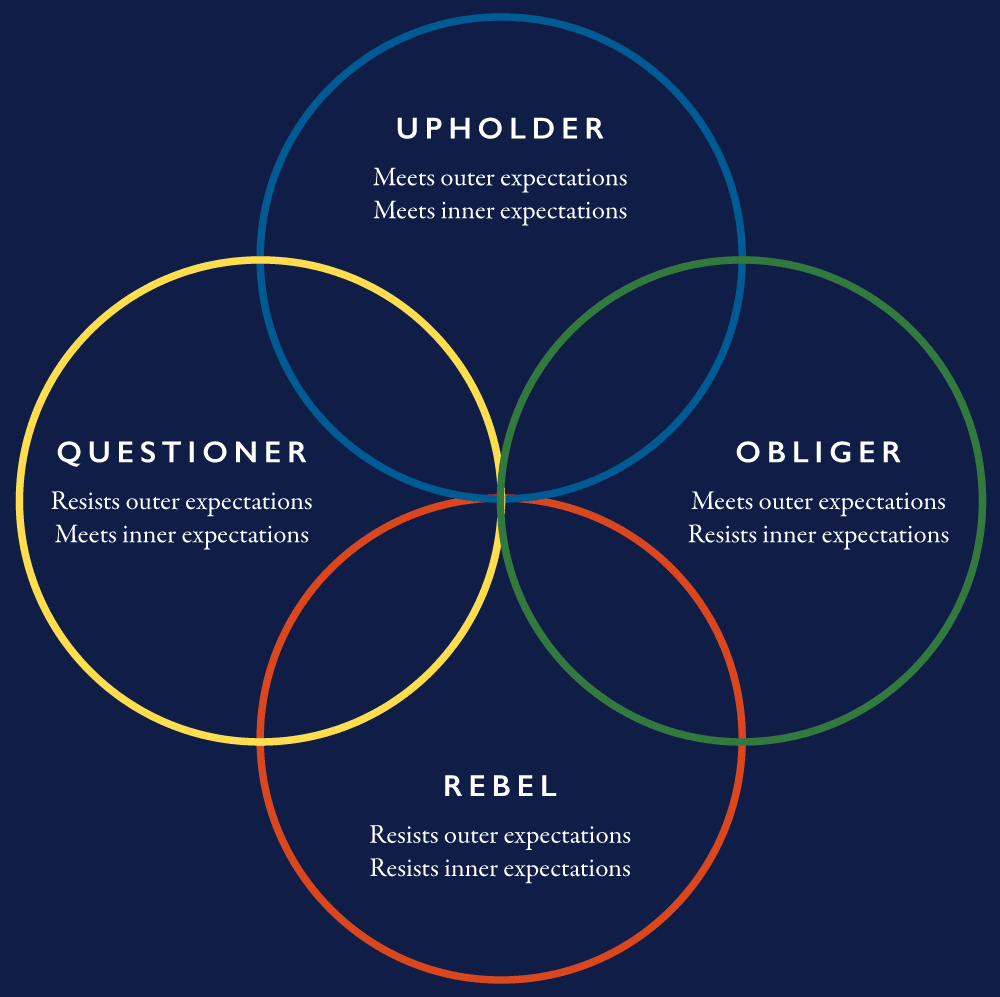
We all face two kinds of expectations: outer expectations (meet work deadlines, answer a request from a friend) and inner expectations (read more, take a daily walk). Your response to expectations determines your “Tendency”—that is, whether you’re an Upholder, Questioner, Obliger, or Rebel.
Created by Gretchen Rubin based on her study of happiness, habits, and human nature, the Four Tendencies personality framework explains why we act and why we don’t. The framework is designed to help you understand yourself better, communicate with others more effectively, and create the life you want.
Get to Know Each Tendency
Two of life’s big, daily challenges? Building important habits and navigating relational differences. The Four Tendencies framework makes both of these challenges much easier. When we understand our own Tendency, we can adapt our circumstances to achieve our aims. When we understand other people’s Tendencies, we can engage with more empathy—whether in the workplace, at home, or beyond. Remember, there’s no “best” or “right” Tendency. Each Tendency has its strengths and weaknesses. The trick is to harness the power of each Tendency (and mitigate its weaknesses) to build a happier life.
Core Motto:
“Discipline is my freedom.”
Strengths:
- Upholders readily meet external and internal expectations.
- They’re self-directed and have little trouble meeting commitments, keeping resolutions, or hitting deadlines (they often finish early).
- Others can rely on Upholders, and Upholders can rely on themselves.
- They generally want to understand the rules, and often they search for the rules beyond the rules—as in the case of art or ethics.
- Because Upholders feel a real obligation to meet their expectations for themselves, they have a strong instinct for self-preservation, and this helps protect them from burn-out.
- They embrace habits and form them fairly easily, because they find habits gratifying.
Weaknesses:
- Upholders have a hard time deviating from routine or adjusting to scheduling changes, which can make them seem rigid and inflexible.
- They may feel compelled to meet expectations, even ones that are unnecessary or pointless.
- They hate to make mistakes, and because of that they may become defensive when you suggest that they’ve dropped the ball or done something wrong.
- They may have trouble delegating responsibilities, because they suspect that others aren’t dependable
- They may be judgmental of those who won’t or don’t meet expectations easily.
Top strategy for achieving your aims: Scheduling
- When it comes to building habits, the key for Upholders is to harness their natural tendency to meet expectations and follow rules. That’s what makes the Strategy of Scheduling so powerful. Simply put, this strategy means blocking off a specific time for a habit or an aim. Upholders love to keep a schedule and march through every item, and they thrive on routines and clear expectations. Whatever appears on the calendar—go to the gym on Monday and Thursday, write 1,000 words every day, goof off—gets done.
Core Motto:
“I’ll comply—if you convince me why.”
Strengths:
- Questioners question all expectations. Once they decide an expectation or a habit is justified, they have no trouble following through.
- They put a high value on reason, research, and information.
- Because Questioners want to make well-considered decisions and come to their own conclusions, they tend to be intellectually engaged, and they’re often willing to do exhaustive research.
- They are interested in creating systems that are efficient and effective.
- They’re willing to play devil’s advocate or buck the system if warranted.
- They often spot problems or identify solutions that others overlook.
Weaknesses:
- Questioners can suffer from “analysis-paralysis,” when they find it difficult to make a decision or move forward because they keep wanting more information.
- People may feel overwhelmed by a Questioner’s relentless appetite for information and justification. Their persistent questioning may make them seem uncooperative or defiant.
- They may be unable to accept closure on matters that others consider settled.
- They often dislike being questioned themselves, and may resist answering others’ questions. They consider their actions carefully, so they find it tiresome to be asked to justify their decisions.
- They follow the advice of “authorities” only if they trust their expertise, and often follow their own judgment even when it flies in the face of experts who (allegedly) know more.
Top strategy for achieving your aims: Clarity
- Questioners question all expectations and will meet an expectation only if they believe it makes sense. They resist anything arbitrary or inefficient, and they need reasons for everything they do. The good news: once a Questioner is convinced a habit is worth building, they can be very dedicated. This is where the Strategy of Clarity comes in. This strategy means being crystal clear with yourself and others about what you’re trying to achieve and why. Ask yourself why this habit matters to you—not why it should matter. Understanding the genuine motivation behind a habit is what gives it staying power. Then frame the habit in a specific, concrete, and measurable way. For example, instead of “Spend more time with my kids,” clarify the habit to something like, “Read to my kids for twenty minutes every night before bed.”
Core Motto:
“You can count on me, and I’m counting on you to count on me.”
Strengths:
- Obligers are motivated by external accountability; they wake up and think, “What must I do today?”
- They excel at meeting external demands and deadlines and go to great lengths to meet their responsibilities.
- They tend to be reliable and responsible, and make terrific colleagues, leaders, family members, and friends.
- They are willing to go the extra mile.
- They put a high value on meeting commitments to others—“I’ll do anything for a client/patient/family member.”
Weaknesses:
- Others rely on them, but because Obligers resist inner expectations, it can be difficult for them to meet their aims for themselves—to work on a Ph.D. thesis, to attend networking events, to get their car serviced.
- Obligers depend on external accountability, with consequences such as deadlines, late fees, or the fear of letting other people down. They even need external accountability for activities that they want to do.
- The weight of outer expectations can make Obligers susceptible to burnout, because they often have trouble setting limits or telling people “no.”
- Burnout may lead to “Obliger-rebellion,” a striking pattern in which they abruptly refuse to meet an expectation.
- They may have trouble delegating, because they feel that some expectations attach to them personally.
Top strategy for achieving your aims: Accountability
- All Four Tendencies (even, under certain circumstances, Rebels) find accountability to be useful for developing habits, but Obligers absolutely require it. They need oversight, deadlines, and consequences, and the involvement of accountability partners such as coaches, classes, trainers, friends, or their own children. To form habits—which are a type of inner expectation—Obligers can harness the Strategy of Accountability. Having someone else to answer to—whether it’s a friend, coach, or group—makes all the difference in helping Obligers stick to their habits. Some examples of accountability structures include signing up for a class that requires weekly assignments to improve your photography skills, downloading a language learning app that sends you daily reminders and tracks your streak, or scheduling twice-weekly walks with a friend who expects you to show up on time.
Core motto:
“I do what I want when the time feels right.”
Strengths:
- Rebels place a high value on authenticity and self-determination, and bring an unshackled spirit to what they do.
- They work toward their own goals using their own methods, rather than following the path they’re “supposed” to take. They love to meet a challenge in their own way, in their own time.
- They put a high value on freedom, choice, self-expression, and authenticity.
- They tend to be independent-minded and able to think outside the box.
- Because they are unswayed by conventional opinion, they’re often willing to buck social conventions.
Weaknesses:
- Rebels struggle with mandatory or repetitive tasks, and are often repelled by routine and planning.
- They may act as though ordinary rules don’t apply to them.
- They can be restless and may find it difficult to settle down in a job, relationship, city.
- They have trouble telling themselves what to do—even when it’s something they want to do.
- If someone asks or tells them to do something, they’re likely to resist.
- They don’t respond well to supervision, advice, directions, routines, or schedules.
Top strategy for achieving your aims: Identity
- Rebels resist both outer and inner expectations. They want to do what they want, in their own way, on their own time. Traditional habit advice—set a schedule, find an accountability partner, keep up a streak—is largely counterproductive. For Rebels, the most effective habit-change strategy is the Strategy of Identity. Because Rebels place great value on being true to themselves, they can embrace a habit if they view it as a way to express their identity. This requires framing a habit as an expression of who you are. Every identity—athlete, artist, environmentalist, reliable parent, strong leader—carries certain habits with it. Reminding yourself, “I’m the kind of person who thrives on physical challenges” is more motivating than “I should exercise regularly.” To successfully build and keep a habit, first articulate how the habit supports and aligns with your identity.
Using the Tendencies to Build Habits, Reduce Conflict, and Navigate Relationships
The Four Tendencies framework gives us a richer understanding both of ourselves and other people. Knowing our own Tendency equips us to build lasting habits and achieve our aims. Knowing other people’s Tendencies enables us to live together more harmoniously. By applying the Four Tendencies framework to our relationships, we can navigate differences and communicate more effectively—whether with children, colleagues, or romantic partners. We don’t take their actions personally; we’re not mystified by what they do. Instead, we can focus on creating an environment where everyone can thrive.
Whether we’re dealing with a boss, colleague, employee, client, or customer, the Four Tendencies helps us understand other people’s perspective and why they act the way they do. Understanding how the Tendencies play out in the workplace means more collaboration and less conflict, because when we understand other people’s perspectives, we can work with them more effectively and compassionately.
| Further Reading and Listening: |
|---|
Schoolwork, household chores, morning and bedtime routines, sports and activities, and socializing with friends and family members all come with expectations. Knowing how a child responds to expectations can help cultivate empathy and reduce disagreement. Whether you’re an educator, a parent, a caregiver, a coach, or anyone else who interacts regularly with children, understanding the Tendencies paves the way for better communication with kids.
| Further Reading and Listening: |
|---|
When dealing with a romantic partner, we can use the Four Tendencies to help us understand our sweetheart’s perspective and why they act the way they do. Whether you’re trying to divvy up domestic labor, navigate parenting, or resolve nagging conflict, understanding your partner’s Tendency is crucial. This knowledge can help you strengthen your relationship by alleviating resentment, boosting understanding, and communicating in a way that both partners understand.
| Further Reading and Listening: |
|---|
If you’ve ever wondered why some people seem to effortlessly train for a marathon while others struggle to take their daily vitamins, the answer likely has to do with the Tendencies. To change your habits, it’s crucial to work with your Tendency. That’s because building a new habit means setting an inner expectation for yourself. People of all Tendencies can successfully build and keep habits—the trick is to do so in the way that works for you.
Further Reading and Listening: |
|---|
Frequently Asked Questions
Still curious? Below you’ll find answers to some of the most common questions about the Four Tendencies framework.
From my observation, everyone has a core Tendency. However, each Tendency interlocks with two other Tendencies, and a person of a particular Tendency often “tips” in the direction of one of the overlapping Tendencies. Whether you tip to one side or the other may dramatically affect how your Tendency presents itself.
For instance, a Rebel who “tips” to Questioner concentrates more on fulfilling their own desires than on resisting outer expectations; the Rebel spirit of resistance remains strong, but they’re more focused on doing what they want than on defying other people. By contrast, a Rebel who tips to Obliger has a stronger inclination to push back and evade control. The Obliger and Rebel Tendencies both resist inner expectations, a state that fuels resentment and resistance.
Here are some common reasons people think they’re more than one Tendency:
If you think you’re a mix of Obliger and Rebel: There’s a very strong affinity between Rebels and Obligers. It’s very common for Obligers to experience “Obliger-rebellion,” a striking pattern in which every once in a while, they abruptly refuse to meet an expectation. As one Obliger explained, “Sometimes I ‘snap’ because I get tired of people making assumptions that I’ll always do things as expected. It’s sort of a rebellious way of asserting myself.”
If you think you’re a Questioner/Upholder or Questioner/Rebel: Questioners come in two flavors. Some Questioners lean toward Upholder, and others lean toward Rebel. For instance, my husband questions everything, but it’s not too hard to persuade him to uphold; other Questioners ask so many questions that they’re practically Rebels, because it’s so hard to convince them to do anything. But they ultimately act from a questioning spirit, not a rebelling spirit.
If you think you’re a mix between Upholder and Obliger: Upholders and Obligers share a tendency to meet outer expectations, so in that way, they are indeed very much the same. The key difference is: Can you meet an expectation you impose on yourself, that no one else knows or cares about? If you struggle to meet those expectations, you’re an Obliger. Very few people are Upholders; many, many people are Obligers.
Obliger-rebellion is what happens when an Obliger has met expectations to the point of burnout—and then suddenly snaps.
When Obligers feel exploited, over-taxed, unappreciated, or ignored, or when the weight of expectations feels unbearable, they experience mounting anger and resentment. If expectations continue to press, the Obligers’ anger builds to the bursting point and they rebel. This rebellion can be small and symbolic (refusing to answer someone’s texts, refusing being deliberately late for work) or it can be huge and fateful (ending a twenty-year friendship, quitting a job).
Someone in the midst of Obliger-rebellion may explode or blow up over seemingly-insignificant requests or expectations. They may refuse to meet responsibilities they’ve always handled or make a dramatic announcement, such as resigning from a job or volunteer position. Sometimes, Obliger-rebellion is aimed at the self. If Obligers don’t feel safe directing the rebellion outward, they may turn it inward and engage in self-sabotage—for example, refusing to prepare for an important interview not completing schoolwork that could easily have been done.
In general, once it starts, Obliger-rebellion needs to run its course. And while it can have destructive effects, Obliger-rebellion is meant to be a constructive phenomenon—it’s the emergency parachute that allows an Obliger to escape from a situation where expectations are just too high. Obliger-rebellion can allow someone can get out of a bad marriage, a bad job, or a bad relationship.
For tips on how to deal with Obliger-rebellion in yourself or others, read more here.
It’s not possible to discern someone’s Tendency just from looking at their external behavior; it’s also necessary to understand their reasoning. A friend said, “I’m a Questioner. But I’ve had a lot of experiences where the rules were so stupid that I looked like a Rebel, because I refused to do what anyone asked me.”
The Four Tendencies framework tells us how we meet an expectation, not a requirement. When we must do something, we do it—even Rebels. What matters is what we do, and why we do it.
In a nutshell, here’s what motivates each Tendency to act:
- Upholders want to know what should be done.
- Questioners want justifications.
- Obligers need accountability.
- Rebels want freedom to do something their own way.
Always trust yourself. Occasionally, when people take the quiz, they answer while thinking about one particular area of their lives, and that can make the result point in the wrong direction. Or people give the answers they wish were true, or think ought to be true. Often, if there’s any doubt, when people read The Four Tendencies book, their Tendency becomes quite clear—because all the examples, frustrations, and strategies related to one Tendency ring very true, much more so than the others.
Of course, no matter what our fundamental Tendency, a small part of each of us is Upholder, Questioner, Obliger, and Rebel:
- All of us meet an expectation when we don’t want to bear the consequences of ignoring it. The Rebel wears his seat belt after he pays a few big fines.
- All of us may question why we should have to meet an expectation, or become annoyed by inefficiency, or refuse to do something that seems arbitrary.
- We all meet some expectations because they’re important to someone else. The most determined Upholder will sacrifice her regular morning workout if her child is recovering from surgery.
- We all desire autonomy. We prefer to be asked rather than ordered to do something, and if our feeling of being controlled by others becomes too strong, it can trigger “reactance,” a resistance to something that’s experienced as a threat to our freedom or our ability to choose.
But if you feel very strongly that you’re all four, that’s a good indication that you’re a Questioner. Why? Partly because the Questioner Tendency is the least distinctive Tendency. Upholders, Obligers, and Rebels recognize how they’re different from other people. But Questioners view their questioning not as evidence of a pattern but merely the logical, universal response to life.
Rebels tend to resist if someone asks or tells them to do anything. It’s very important—but challenging—to avoid setting off their spirit of resistance. They dislike supervision, advice, nagging, or reminders; when you remind a Rebel to do a task, you’re probably making it less likely that they will do it.
So how can you inspire a Rebel to act? Here are three tips:
- Try framing an expectation using information-consequence-choice. For example, if you’re a parent with a high school student, you might say: “The school circulated this form for seniors to submit their three top choices for each elective. If you hand in your scheduling form on time, you’ll be more likely to get your top choices. If you hand in the form late, you’ll be stuck in the unpopular classes. Here’s the form.” Or, if you’re a manager speaking to an employee who never attends a mandatory weekly video call, you might try this: “In the weekly call, we divvy up the interesting projects among the people who are there. We assign the boring stuff to the people who skip!”
- Appeal to their identity. Because Rebels place great value on being true to themselves, they willingly meet expectations if they view them as a way to express their identity. Consider how a Rebel identifies themselves—as an artist, an athlete, a loving family member, a reliable friend, a strong leader—and highlight why a particular expectation aligns with this identity.
- Make it a challenge. Rebels often enjoy a challenge. Because of this, their spirit of resistance can work in their favor (“I’ll show you!” “Watch me.”) For example, if your colleague is a Rebel, you’ll know that she needs freedom and choice with as little supervision and accountability as possible. Tell her, “You’ve got the chops to get this project done! Let me know if you run into any roadblocks; otherwise, I can’t wait to see how you choose to solve this.” If you’re a parent whose Rebel child struggles with a morning routine, try this: “Bet you can’t get ready in less than two minutes, can you beat your old record?”
The Four Tendencies in Action Workbook
Understanding your Tendency—whether you’re an Upholder, Questioner, Obliger, or Rebel—provides insight into common frustrations related to personal habits and relationships. More than that, the framework offers a roadmap for harnessing your Tendency’s strengths and communicating effectively across different Tendencies, whether with kids, coworkers, or romantic partners.
The Four Tendencies in Action workbook helps you apply the framework to build the life you want. Inside you’ll find written exercises, personalized toolkits, playful quizzes, and scripts for specific scenarios, all designed to help you achieve your aims and interact more compassionately with others. Work through it at your own pace, and keep it handy for whenever you’re starting something new or struggling to make a change stick.
The Four Tendencies Book
During her multibook investigation into human nature, Gretchen Rubin realized that by asking the suspiciously simple question “How do I respond to expectations?” we gain explosive self-knowledge.
Rubin discovered that people fit into Four Tendencies: Upholders, Questioners, Obligers, and Rebels. Our Tendency shapes every aspect of our behavior, so understanding this framework lets us make better decisions, meet deadlines, suffer less stress and burnout, and engage more effectively. The Four Tendencies explain why we act and why we don’t act.