Last week, I went to Austin, Texas, to attend the giant conference SXSW. Boy, I love a conference. I love people wearing badges that act as name tags, the predictability of a corporate hotel, the chance to talk shop, the scrutinizing of the schedule to choose the most interesting events. My one-word theme for 2026 is “Neighbor,” and I really pushed myself—much more than I would naturally do—to speak to people sitting next to me or waiting in line near me. It was worth the effort; I had many unexpectedly great conversations.

Onward,

5 Things Making Me Happy​

Today, March 20, is the first day of spring—which always feels like a very auspicious day. I like to celebrate minor holidays, and maybe I’ll start some kind of fun tradition around the first day of each season. I don’t know what that tradition or ritual might be, but I like the idea.

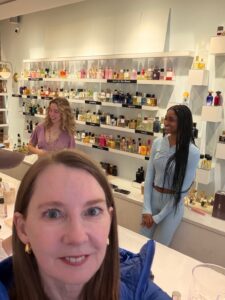
Speaking of days of the year, Saturday is National Fragrance Day. I love smells of all kinds, particularly perfume. Recently, a friend and I went to Scent Bar and Stele, two interesting downtown perfumeries. So many beautiful—and not so beautiful—perfumes! I also like looking at the perfume bottles; like the album cover or cookie tin, it’s a very satisfying commercial form.

Trend alert: Chaos decluttering. For me, outer order leads to inner calm, and I’m always intrigued by any clutter-control strategy. (One of my favorite things to watch on Instagram is a sped up, before-and-after video of a disastrously messy room becoming orderly.) I was interested to read the article “I tried the chaos decluttering method—it’s brilliant but better for smaller areas and definitely NOT for the easily overwhelmed.” It’s described as the “exact opposite” of Marie Kondo, though if I remember correctly, Marie Kondo proposes this strategy herself. It’s not my favorite approach, because you do create a lot of disorder before you get to order—which can be inconvenient or daunting. But it can be very effective.

People tell me all the time, “I want to develop the habit of regular exercise.” We all know that exercise is a key to good health, but it can be hard to keep up. I’ve learned that it’s much easier to exercise when you pick the form of exercise that is right for you, that suits your preferences, interests, and rhythms. If you want to identify the particular kind of exercise that will suit you best, ask yourself these eleven questions.

We all know how tough it is to navigate conflicts at work—feelings of resentment, anger, frustration, or sheer bafflement. When I visit an office, I always make sure to visit the kitchen to read the signs posted there; they hilariously encapsulate so many workplace issues. (I would love to create a coffee-table book of handwritten office signage.) I’ve realized that often, there’s a very predictable pattern behind these conflicts, and when you understand it, the issues are much easier to spot and solve. On March 25th, I’m doing a LinkedIn Premium virtual event about how to spot that pattern and what you can do about it.

SPONSORED BY TRADE COFFEE

A Fresh Cup, Made Just for You

A great cup of coffee is a simple daily pleasure. Trade brings you fresh, roasted-to-order coffee from the country’s best small roasters. Take the quick quiz to find your perfect match and save up to 40% on your first month.

This week on Happier with Gretchen Rubin

PODCAST EPISODE: 578

Do You Dread Giving a Toast? And You Probably Want the Same Snack

Listen now >

INTERVIEW

Deepika Chopra

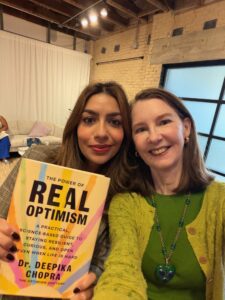
Dr. Deepika Chopra (a.k.a. the The Optimism Doctor®) is a professional psychologist, visual imagery expert, and founder of Things Are Looking Up®, a consultancy devoted to the intersection of science and soul. Her new book, The Power of Real Optimism is out now. By coincidence, I ran into Deepika backstage at SXSW.

Q: Can you suggest something we might try to help ourselves to become happier, healthier, more productive, or more creative?

I’m going to say something that sounds counterintuitive: schedule time to worry.

I know. I’m telling you to worry. Stay with me.

Instead of trying to suppress anxious thoughts all day, put 15 minutes of “worry time” on your calendar. When a worry pops up earlier, write it down and tell yourself, “I’ll think about this at 4:30.”

When that time comes, look at the list and ask: Is there anything I can actually do about this? If yes, identify one next step. If no, practice letting it rest — at least until tomorrow’s worry time.

Research shows that containing worry reduces rumination and increases focus. Giving it structure often makes it smaller. The brain doesn’t need us to eliminate worry; it needs us to relate to it more skillfully.

Q: Do you have a Secret of Adulthood? A lesson you’ve learned from life the hard way; something you’d tell your younger self?

Most things that feel permanent aren’t.

As adults, we tend to catastrophize discomfort. A difficult season feels like a verdict. But so much of what we interpret as “this is how it will always be” is actually transitional.

If I could tell my younger self anything, it would be this: don’t confuse intensity with permanence. Hard does not mean forever.

Q: What simple habit boosts your happiness or energy?

In addition to a to-do list, I keep a “ta-da” list.

At the end of the day, I write down what I actually did — not what’s left undone. It might be as simple as “had the hard conversation” or “made dinner when I didn’t feel like it.”

Our brains are wired to scan for what’s incomplete. A ta-da list gently corrects that bias. It reminds you that you’re moving, even when progress feels invisible.

And then — this one is more personal — since the start of COVID in 2020, I’ve been practicing something I call “wake up and dance.”

The very first thing I do when I wake up is turn on music and dance. Sometimes it’s 30 seconds. Sometimes it’s longer. It depends on how much time I have and whether my three kids are already climbing on me. But I do it wherever I am — kitchen, hotel room, hallway.

Music is kind of my thing.

It shifts my nervous system before my phone gets a chance to. It reminds me that I have a body, not just a to-do list. And starting the day with even a tiny moment of joy changes the tone of everything that follows.

Q: Is there a particular motto that you’ve found very helpful?

“Name what’s real. Choose the next right move.”

The first part keeps me grounded. The second part keeps me from spiraling. I don’t have to solve everything — I just have to identify the next honest step.

That idea is at the heart of my work and my book, The Power of Real Optimism. Optimism isn’t about pretending things are fine. It’s about acknowledging what’s difficult while leaving a small crack open for possibility — and then taking one actionable step forward.

Q: Has a book ever changed your life?

Kafka on the Shore by Haruki Murakami.

It was the first book that made me aware of a very specific emotional paradox: as I turned each page, I felt a small ache — I was one page closer to the end — and at the same time, I felt eager for what was coming next.

I remember thinking: this is what living feels like.

We are always leaving something behind while stepping into something new. That bittersweet tension — longing and anticipation coexisting — shaped how I understand happiness.

It’s not about holding onto the page you just finished. It’s about allowing yourself to feel the ache — and still turning the page.

Listen to the Happier podcast?
Click here to read the show notes.

You signed up to receive this newsletter at gretchenrubin.com

{{ organization.name }} {{ organization.full_address }}

Subscribe to Gretchen’s newsletter.

Every Friday, Gretchen Rubin shares 5 things that are making her happier, asks readers and listeners questions, and includes exclusive updates and behind-the-scenes material. 

;