I’m a big fan of April Fool’s Day; I love a gentle, fun prank that makes everybody laugh. This April 1, I pulled off my most successful family trick ever. Stay tuned for next week’s newsletter for my big reveal! For this newsletter, because April Fool’s Day reminds me of the value of adding humor and whimsy to our lives, I want to highlight the artworks in the Metropolitan Museum that always make me smile as I walk past.
Onward,
![]()
5 Things Making Me Happy
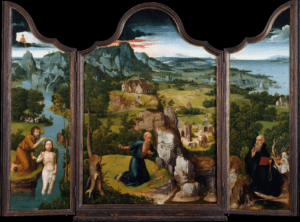
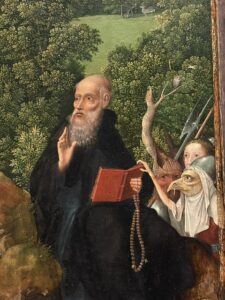
This beautiful triptych, Joachim Patinir’s The Penitence of Saint Jerome, offers a transcendent and serious view of religious subjects. But it cracks me up to see the beaky demon tempting St. Anthony the Hermit. That ugly little guy is tugging on St. Anthony’s book exactly the way my daughter Eleanor used to pull on my book when she wanted my attention.
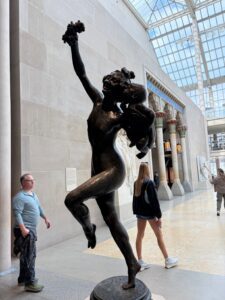
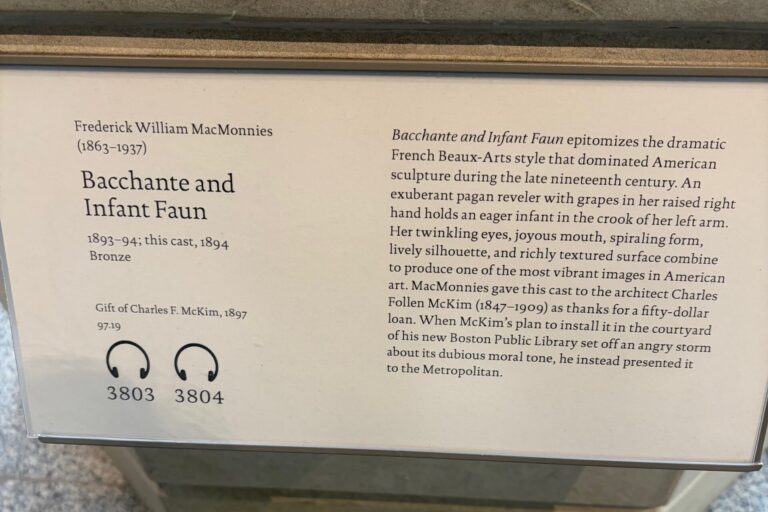
I call this the “selfie statue.” Yes, it’s Frederick William MacMonies’s Bacchante and Infant Faun, but at a glance, doesn’t it look as if that Bacchante is snapping a quick selfie of her and the faun?
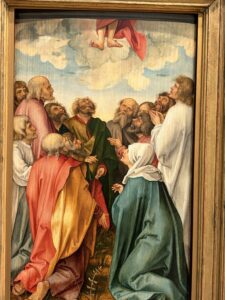
I must confess, I feel irreverent at finding this painting funny. It’s Hans Suss von Kulmbach’s painting of the mysterious and holy moment of The Ascension of Christ — but those feet sticking down from the top of the frame just look funny to me.
Can you see what’s happening in Georges de La Tour’s painting, The Fortune-Teller? Look closely. The woman on the right is picking the young man’s pocket. And doesn’t he look like John Mulaney?
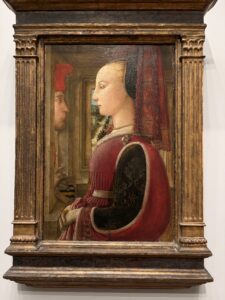
Portrait of a Woman with a Man at a Casement makes me laugh every time. Fra Filippo Lippi, sure—you were a groundbreaking Italian painter who made this earliest surviving double portrait, the first to show sitters in a domestic setting, and the first with a view onto a landscape. But come on, this looks silly.
This week on Happier with Gretchen Rubin
PODCAST EPISODE: 580
Very Special Episode! Ask Us Anything
INTERVIEW
Eric Zimmer
Eric Zimmer is an author, teacher, speaker, and the creator of The One You Feed podcast. At 24, Eric was homeless, addicted to heroin, and facing prison. His journey from those depths sparked his lifelong inquiry into human transformation and resilience. His new book, How a Little Becomes a Lot: The Art of Small Changes for a More Meaningful Life, is out now.
Q: Can you suggest something we might try to help ourselves to become happier, healthier, more productive, or more creative?
Yes, try what I call “still points” into your life.
A still point is a moment of reflection or practice we intentionally build into our day. Because so much of what drives us happens below the surface, we can’t brute-force internal change any more than we can will ourselves into a new habit overnight.
What we can do is create small interruptions— tiny shifts that help our thoughts settle into better grooves over time. That’s what still points are. You can think of them as the fundamental building blocks of a new way of thinking: tiny disruptions that pave the way toward new horizons.
The formula is simple: When-Then. The “When” is a prompt. The “Then” is your chosen response.
Example: When I check the time, then I’ll ask myself: What am I thinking and feeling right now?
Here’s a still point that I used for years. When I walked from my car to the office, I would Then do a practice called “Grounding in Our Senses.” It simply meant noticing five things I could see, five I could hear, and five I could feel in my body. The goal? To practice presence.
Doing this once made no difference, but doing it twice every day, once on the way in and on the way out, started to change my capacity for presence. I found myself more able to take a step back from the stress of the day to notice the sway of the red oaks. The wrens in spring. The crocuses and tulips and marigolds. The bounce of my soles, the beat of my pulse. The grand natural cycles that couldn’t help but make my emails and meetings feel trivial— which had the side benefit of making me feel a little more ready to handle the day’s business. All of that, and I never actually had to carve time out to access this still point. It was found time, a pocket of autopilot action and thought I co- opted for something a little more useful.
Q: Do you have a Secret of Adulthood? A lesson you’ve learned from life the hard way; something you’d tell your younger self?
Just because I think something doesn’t mean it’s true.
One of my favorite phrases of all time comes from Anaïs Nin, who wrote simply: “We do not see things as they are, we see them as we are.”
Knowing that just because I think something doesn’t mean it’s true has probably been the most important Secret of Adulthood to me.
For us humans, there’s simply no such thing as an objective view of reality. Even when I think I’m seeing all the facts, I’m always seeing them through the colored lens of my own perspective. There is no view from nowhere — no perfectly removed perch from which I can see all angles at once. And when I forget that — when I assume the way I’m seeing the world in a given moment is just the way it is, rather than the way it looks to me — I cause myself a lot of needless suffering.
Q: What simple habit boosts your happiness or energy?
Putting on a song I love and turning it up. This one usually works.
Q: Is there a particular motto that you’ve found very helpful?
A little bit of something is better than a lot of nothing.
We often get stuck in an all-or-nothing way of thinking. If I can’t follow my workout routine exactly, then I just don’t do it. If I eat a donut at work in the morning, I give up on my eating plan entirely for the rest of the day.
This reminder that a little bit of something is better than a lot of nothing helps me avoid these extremes. If I miss my morning workout because of an unexpected meeting, maybe I can walk for 20 minutes after dinner. If I plan to write for an hour but the first 20 minutes get eaten up by a long phone call, I can still write for 30. Miss my morning meditation session? How about three minutes of deep breathing on an afternoon break.
What this helps us do is honor the underlying value of what we’re trying to accomplish, and keep our momentum going.
Q: Has a book ever changed your life?
So many books have changed my life. On the Road, When Things Fall Apart, East of Eden, Seven Habits of Highly Effective People, and all of the Calvin and Hobbes books.
But for today, I’ll choose Zen Mind, Beginner’s Mind by Shunryū Suzuki. This book was given to me by my high school science teacher. I’ve studied Zen for about the last 30 years, and I still don’t understand a lot of it. But back then I’m sure I understood almost nothing. But I intuited that it was talking about a way of being in the world where I could be okay, no matter what was happening. And as an angsty teenager, it was obvious to me that the world presented a smorgasbord of difficulty and suffering.
That idea — that I could be okay even in the midst of those things — stuck with me and guided so much of my future seeking. And I’m happy to report that it turns out to be true. In the midst of great difficulty and pain, there is a way to find an underlying okay-ness.
You signed up to receive this newsletter at gretchenrubin.com