
An earlier version of this article appeared January 19, 2015
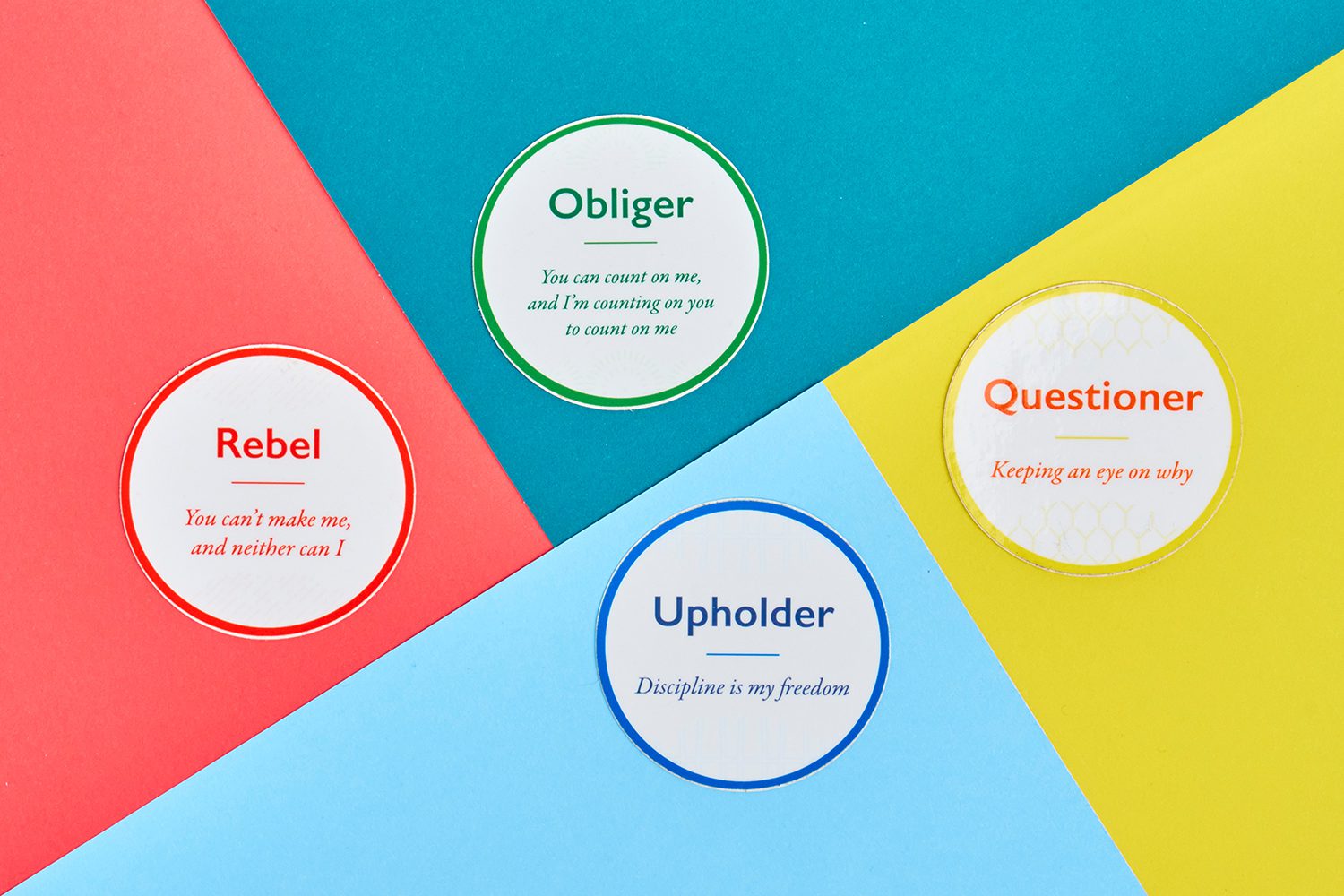
My Four Tendencies framework divides people into four types based on how they respond to expectations: Upholders meet both outer and inner expectations readily; Questioners meet expectations only if they have good reasons; Obligers meet outer expectations but struggle with inner ones; and Rebels resist all expectations, inner and outer alike.
I developed this framework as part of my research on habits for my book Better Than Before, and I’ve been gratified that so many thousands of people have taken the quiz to discover their own Tendency.
I’ve received so many fascinating comments and questions over the years that I thought this would be a good time to make some observations.
First, the quiz is meant to be a tool. It’s not infallible. Your evaluation of your own Tendency matters most. The particular questions, the particular wording of the questions, may lead to the incorrect answer for you. Use your own judgment.
As one reader pointed out, the quiz is helpful either because it tells you what you are, or because you disagree with the quiz, you figure out what you are instead!
Discover Your Tendency
It’s easier to succeed when you know what works for you. Understand your Tendency to make better decisions, meet deadlines, suffer less stress, and engage more effectively.
Can you be a mix of two Tendencies?
Many people argue that they’re a mix of two Tendencies. This sounds sensible. And it also sounds sensible to think that “I’m X at home, and Y at work.” But from my observation, that’s not really true. Whenever I sit down with someone who says he or she is a mix, and put them through some questions, I find that (in my view), that person is actually firmly within one category.
Here are some common combinations, and why people think they’re a mix, and how you might think about it.
If you think you’re an Obliger/Rebel: There’s a very strong affinity between Rebels and Obligers. It’s very common for Obligers to experience “Obliger-rebellion,” a striking pattern in which every once in a while, they abruptly refuse to meet an expectation. As one Obliger explained, “Sometimes I ‘snap’ because I get tired of people making assumptions that I’ll always do things as expected. It’s sort of a rebellious way of asserting myself.” Another added, “I work very hard to keep my commitments to other people, but I’ll be darned if I can keep a promise to myself . . . Though every once in a while I will absolutely refuse to please.”
Obligers may also rebel in symbolic ways, with their hair, clothes, car, and the like. For instance, Andre Agassi is an Obliger, and in his memoir Open, he describes ways in which he would Obliger-rebel (though he doesn’t use that term, of course).
If you think you’re a Questioner/Upholder or Questioner/Rebel: Questioners come in two flavors: some Questioners lean toward Upholder, and others lean toward Rebel (like being “Virgo with Scorpio rising”). For instance, my husband questions everything, but it’s not too hard to persuade him to uphold; other Questioners ask so many question that they’re practically Rebels, because it’s so hard to convince them to do anything. But they act from a questioning spirit, not a rebelling spirit.
If you think you’re an Upholder/Obliger: Upholders and Obligers share a tendency to meet outer expectations, so in that way, they are indeed very much the same. The key difference is: Can you meet an expectation you impose on yourself, that no one else knows or cares about? If you struggle to meet those expectations, you’re an Obliger. It’s true that some Obligers have such a wide sense of external expectation that it almost looks like an inner expectation: “I have to do this because ‘they’ say I have to” when the “they” is society at large; or “this is what people have to do do.” Nevertheless, in my framework, they’re responding to an outer expectation. Very few people are Upholders; many, many people are Obligers.
You can’t discern Tendency from the outside
An important note: It’s not possible to discern people’s Tendencies from looking at their external behavior; it’s also necessary to understand their reasoning. For instance, one Obliger told me, “I’m an Obliger. I looked like a Rebel in college, but I was doing exactly the rebellious things that my friends expected of me.” A friend said, “I’m a Questioner. But I’ve had a lot of experiences where the rules were so stupid that I looked like a Rebel, because I refused to do what anyone asks me.”
Also, there’s an enormous range of personality, even among people who share the same Tendency. Some people are more or less considerate than others, or ambitious, or conscientious, or judgmental, or controlling, or thrill-seeking. These qualities dramatically influence how they express their Tendencies. A Rebel who wants to be a successful business leader will behave differently from one who doesn’t care much about work. A Questioner who is very thoughtful will have different habits from one who doesn’t worry much about other people’s comfort or concerns. I have an Obliger friend who is tremendously analytical and intellectually curious. So she questions everything…but when it comes to what she does, she’s an Obliger.
Remember, too, this framework has to do with how we meet an expectation, not a requirement. When we must do something, we do it—even Rebels. My Rebel friend started wearing his seat-belt after he got two huge fines. An Obliger might quit smoking, on her own. No one wants to get fired.
Whatever our Tendency, we all share a desire for autonomy. If our feeling of being controlled by others becomes too strong, it can trigger the phenomenon of “reactance,” a resistance to something that’s experienced as a threat to our freedom or our ability to choose. If we’re ordered to do something, we may resist it—even if it’s something that we might otherwise want to do.
And no one likes to be asked to do something arbitrary or irrational. The desire to know why we should do something, to have justifications for our efforts, is natural. The fact that you question whether you should have to do something that seems senseless doesn’t necessarily mean you’re a Questioner. Again, what matters is what we do, and why we do it.
Can you change your Four Tendencies type?
From what I’ve observed, our Tendencies are hardwired, and while they can be offset to some degree, they can’t be changed.
Yet whatever our Tendency, with greater experience and maturity, we can learn to counterbalance its negative aspects. As an Upholder, for instance, I’ve learned to resist my first inclination to meet an expectation unthinkingly, and to ask, “Why am I meeting this expectation, anyway?” Questioners learn to put a limit on their questioning; Obligers figure out how to give themselves external accountability; Rebels choose to do things because they’ve learned the consequences of not doing them, or out of consideration for others.
Learning to make the best of our own nature is wisdom.