
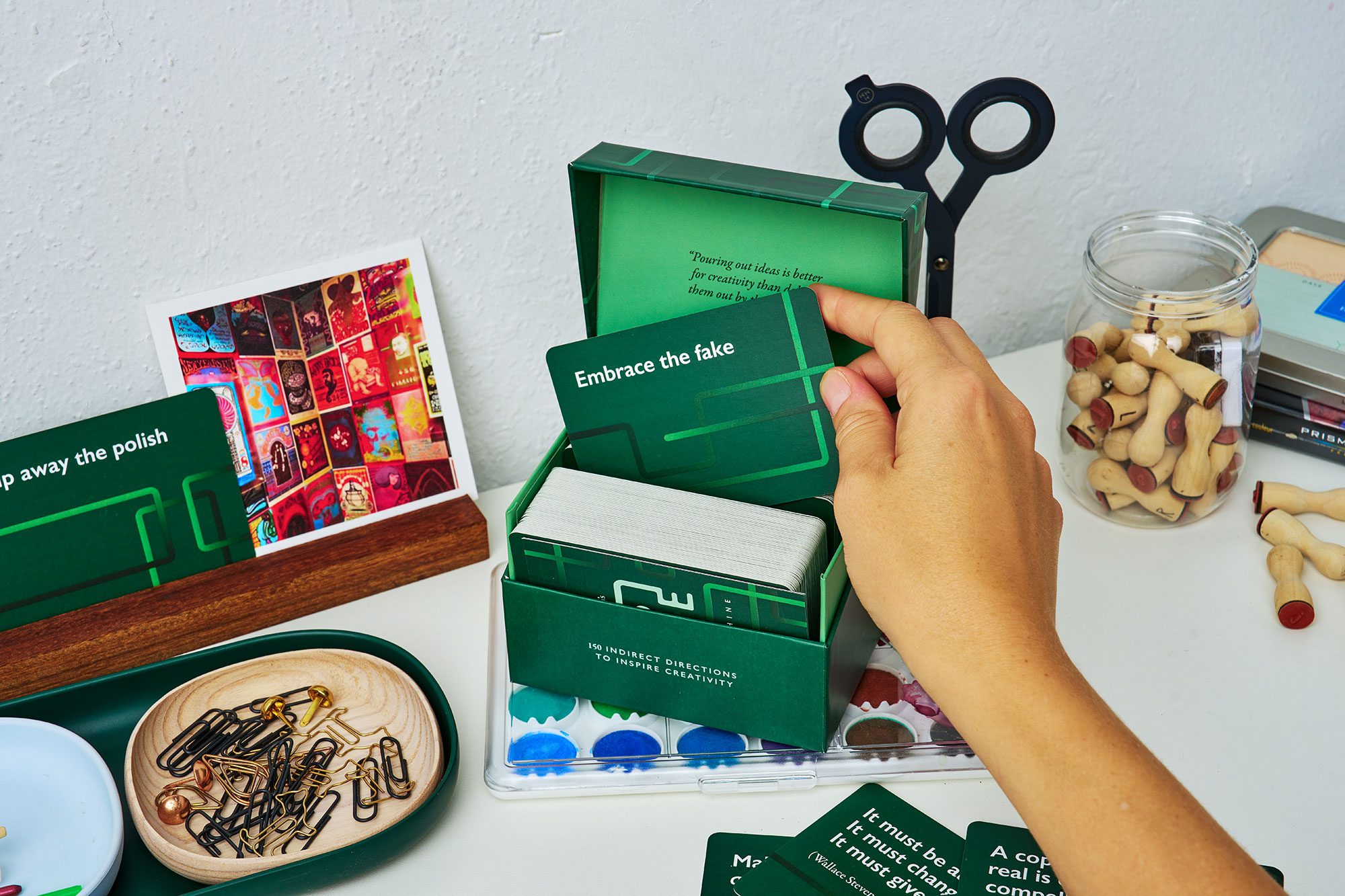
Sometimes, when I’m working on a project, I hit a roadblock. Then, as I’m struggling to move forward, I hear an offhand comment, or I read some thought-provoking phrase, and with that kind of “indirect direction,” I get a sudden idea.
As one of my hooky projects while writing Life in Five Senses, I made a list of “indirect directions” to help me generate creative ideas. When I felt stuck, I reviewed my list. These directions often helped.
What is an indirect direction?
An indirect prompt is a short, open-ended phrase, such as “miniaturize it” or “add a ghost,” that you can apply to a problem you’re stuck on. They aren’t necessarily meant to be taken literally–rather, they nudge your thinking in a new direction.
The Muse Machine: A creative prompt deck for getting unstuck
As a digital document, my list of indirect directions felt insubstantial. I wanted to make it real.
I turned my messy DIY creativity-generator into a beautiful finished product. It’s such a thrill to hold the Muse Machine in my hands and pull out a card at random.
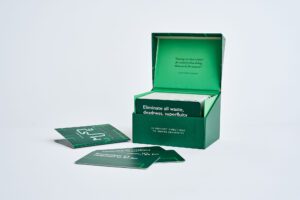
The Muse Machine is a deck of 150 cards with (somewhat mysterious) creative prompts to consult whenever you feel stuck. These indirect directions are short, suggestive, and open-ended, so that they ignite unexpected insights.
Generating creativity with an open-ended prompt
Here’s an example of how I’ve used this deck myself.
Back when I created my own messy, DIY version of this tool, I wanted to find a better name than “Indirect Directions,” but I couldn’t think of anything. So I pulled one of my cards and read, “Find a fresh metaphor.”
Some days later, during one of my daily visits to the Metropolitan Museum, the sight of the earthenware Inkstand with Apollo and the Muses gave me my metaphor.
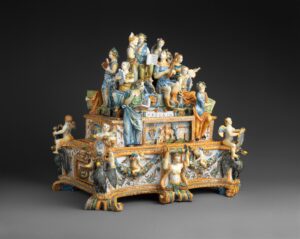
The inkstand, made in Urbino in 1584, is a desk set built to hold a writer’s tools, with Apollo and the Muses perched on top. It’s a working object for writing, decorated with figures believed to inspire creativity.
When I saw it, I thought, “What a great object for a writer! You have all these Muses right there, to power your thinking!”
The card had told me to watch for a metaphor, so when I encountered the right one, I recognized it and my list became the “Muse Machine.”
The deck is useful for any project that calls for creativity, from a novel or a thesis to a holiday toast or the note inside a card, and it makes a good gift for anyone working on something of their own.
I hope you find the Muse Machine as inspiring as I do.
Frequently Asked Questions
What should I do when I feel creatively stuck?
Step away from direct problem-solving. Try an indirect creative prompt, change your surroundings, or add a random constraint, such as limiting yourself to a single element.
How do creative prompt decks work?
A creative prompt deck offers randomized, open-ended statements that encourage lateral thinking. Because you have to interpret an ambiguous phrase in the context of your specific challenge, the prompt pushes you past the approach you’ve been stuck on.