
5 Things from the Happier with Gretchen Rubin podcast
Find your decluttering style
Are you joining the “Move 26” challenge—to move for 26 minutes every day in 2026? All types of movement count — including spring cleaning and organizing. Gretchen and Cas Aarssen, creator of the popular Clutterbug organizational framework, paired up this month for a special Move Happier episode where they talked about decluttering strategies for different personality types.
It’s makeover time
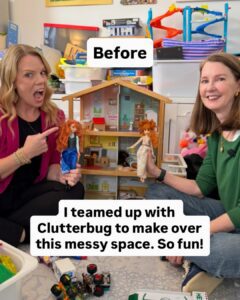
An incredible before-and-after transformation! See Cas and Gretchen’s 48-hour home makeover for Chloe’s cluttered New York City apartment. Watch them design an organizational system that works for Chloe’s Organizational Style (Cricket) and Four Tendencies Type (Obliger). Want to design your own system? Start here.
How to Stop Fighting with Your Family About Clutter
Elizabeth describes her “clutter-blindness,” kicking off a lively discussion about how to share a space with someone who has a different preference for clutter, organization, and abundance.
The Miracle of the Pants
Gretchen and Elizabeth share their favorite clutter-fighting hacks, leading to Elizabeth’s “Miracle of the Pants” story.
More resources for decluttering
If you’re feeling inspired by all this talk of decluttering, check out Gretchen’s favorite resources for organization.
INTERVIEW
Laura Vanderkam
Laura Vanderkam is the bestselling author of seven time-management books and the “Just a Minute” newsletter. She also hosts two podcasts, Best of Both Worlds and Before Breakfast. Her practical, thought-provoking new book, Big Time: A Simple Path to Time Abundance, is out now.
Q: Can you suggest something we might try to help ourselves to become happier, healthier, more productive, or more creative?
Many of us want to spend our time better. I’d suggest that the first step in that process is figuring out where the time is going now. After all, if we don’t know where the time is going now, how do we know if we’re changing the right thing? I have been tracking my time for 11 years now, and while sometimes people think that sounds a bit obsessive (OK, maybe it is) doing this has given me a far more abundant perspective on my time. I can see that there is enough space in the 168 hours we all have each week to do everything that is important to me.
I know that time tracking has been helpful for making me happier and more productive, but when I recommend things to busy people, I want to know that they are worth doing. So, as part of Big Time, I ran a project where 279 people tracked their time for a week (not 11 years! a week is fine!) and reflected on the experience. I measured their feelings about their time in various ways, and I’m happy to report that after tracking time for a week, people were significantly more satisfied with their time in general. Sure, they found some wasted time here and there, but more importantly, they saw that life was pretty good. In most cases, people were spending time on their priorities. The catastrophic stories people were telling themselves (“I work around the clock” or “I never see my family”) weren’t true. There was space for relationships and fun alongside responsibilities.
If you’d like to feel happier about your time, try tracking your time for a week and I think you’ll find the same thing too! You can find various time trackers on my website, or you can just use an app, a notebook, or whatever works for you. The tool doesn’t matter. What matters is that you do it.
Q: Do you have a Secret of Adulthood? A lesson you’ve learned from life the hard way; something you’d tell your younger self?
Small things done repeatedly really do add up. As a corollary to that, patience is a superpower. Lots of people get distracted but if you can just keep chipping away at something, it’s amazing what you can do with time working alongside you. In Big Time, I write about how I and other people have tackled projects like reading War and Peace or all the works of Shakespeare, or listening to all the works of Bach — things I might not have thought I’d have time for earlier in life. War and Peace turns out to have 361 very short chapters, so I read one chapter a day — which only took about 10 minutes — and in a year I was done. Each day felt like only a little more than nothing, but cumulatively, the difference between nothing and a little more than nothing is big. This mindset turns out to work for all sorts of things. If you manage to really get to know 5 people each year in your line of work — people who you admire, and who are cheering for you — in 10 years you’ll have 50 people in your corner. How amazing is that? The time is going to pass anyway. You may as well use it.
Q: What simple habit boosts your happiness or energy?
I know from talking with people about their schedules that weekday evenings are hard to use well. Everyone is tired. But this is a lot of time to write off. We’re looking at 4-5 hours for many people. A little intention goes a long way.
So lately I’ve been writing down one “golden hours” intention on my to-do list each day. (Yep, your golden hours are the hours after work, just as your golden years are the years after you retire.) The intention doesn’t need to be time-consuming. Indeed, it shouldn’t be. Thirty minutes is fine. It might be playing the piano, or working on a puzzle, or reading a book or magazine, but the point is to choose it ahead of time, figure out where it can go (maybe after the kids go to bed), and then notice it as it is happening, so this time can be savored. This simple habit of setting a golden hour intention definitely boosts my happiness.
Q: Is there a particular motto that you’ve found very helpful?
“People are a good use of time.” A lot of people think time management is about being more efficient with time, and it can be. Relationships are sometimes inefficient. You spend time trying to get together with people, and traveling to see them, and people sometimes tell meandering stories that take a long time to get to the point. But so what? What on earth are we saving our time for? Relationships are often the most meaningful parts of our lives. Reminding myself that “people are a good use of time” helps keep any inefficiencies in perspective.

You signed up to receive this newsletter at gretchenrubin.com