
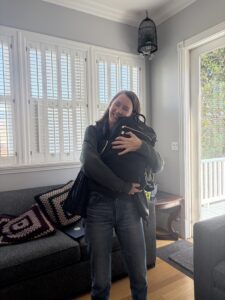
I’m so happy! I’m in San Francisco right now, and although I try to be absolutely diligent about checking behind me every time I leave a place—of course I forgot this step at a crucial moment. I left my beloved backpack in an Uber, but the next day, I got it back. I’m ecstatic! Note to self: Always remember to look behind me when I leave a place.
Onward,

5 Things Making Me Happy
One item on my “26 for 26” list is to watch the hit HBO TV show Girls, and I’m closing in on the last season. It aired from 2012-2017, so I’m a little late—but I love it, of course. I was thrilled to hear that the cast is coming together to do five more episodes, as announced in this hilarious IG post from Lena Dunham. (In that little video, it was amazing to see each person’s characteristic gestures and inflections, just like their characters from long ago.) Now I’m glad I waited so long to watch the show, because to see the abrupt time jump is going to be so interesting.
For years, I’ve been writing my “Secrets of Adulthood”—aphorisms that distill the lessons I’ve learned, mostly the hard way, with time and experience. During my last book tour, readers discovered that an unpublished shadow version of Secrets of Adulthood existed, and kept telling me that they wanted to read it. I’m publishing my Darker Aphorisms on Substack next week; anyone with a paid subscription can see the full collection. One example—and perhaps relevant to some plotlines in Girls—is “How do we judge those who courageously surmount obstacles they’ve put in their own way?”
I loved this article about the “Greenest block in Brooklyn.” Plants, trees, and greenery of all kinds are so important to New York City, and I love the wholesome, neighborly aspect of the competition.
For as long as I can remember, I’ve loved scratch-n-sniff. I still have my ancient scratch-n-sniff sticker collection from childhood, and the perfume strips I gathered from magazines. So I loved this article, sent to me by a thoughtful listener: “The fascinating, smelly history of the scratch and sniff.”
Word watch: hors d’oeuvres, canapés, crudités. All canapés and crudités are hors d’oeuvres, but not all hors d’oeuvres are canapés or crudités. Hors d’oeuvres are small, flavorful, one- or two-bite pieces of food served outside a meal (beforehand or at a cocktail party). Some hors d’oevres are canapes—a small piece of bread, toast, cracker or puff pastry, with a layer like butter or cream cheese, topped with something like cure meat or smoked salmon. Some hors d’oeuvres are crudites—fresh, raw vegetables served in bite-sized pieces. Phew!
This week on Happier with Gretchen Rubin
PODCAST EPISODE: 608
A listener shares a Know Yourself Better discovery, Elizabeth reports on what she learned from her Summer of Off-White Delight, and a recommendation for a new daily game.


INTERVIEW
Meghan O’Gieblyn
Meghan O’Gieblyn is the author of God, Human, Animal, Machine, a finalist for the Los Angeles Times Book Prize in Science & Technology. Her new memoir, Will and Attention, is available now. I’m a huge fan of O’Gieblyn’s work, and I read Will and Attention as soon as it hit the shelves.
Q: Can you suggest something we might try to help ourselves to become happier, healthier, more productive, or more creative?
One thing I’ve started doing lately is keeping a notebook on my nightstand where I write down, before bed, one anecdote or scene from the day. Sometimes it’s a funny observation a friend made. Or a conversation I overheard at a coffee shop. Or the way the garden looked that evening as the sun was setting. I started doing this as a way to wind down at night and did not anticipate how much joy it would bring. It’s made me more attentive to life. Scenarios that would ordinarily be simple annoyances — an argument between two people in front of me in the grocery store line, for example — become interesting because I can write about them. The great thing about this kind of writing is that it forces you to see your life retrospectively, imagining some older version of yourself reading about this period of life, looking back on it fondly. For me, it’s become a way to avoid the default grind that we all fall into from time to time, feeling that time is slipping through our hands, or that each day is just a mindless repetition of the last. New and interesting things are happening all the time, so long as you train yourself to notice them.
Q: Do you have a Secret of Adulthood? A lesson you’ve learned from life the hard way; something you’d tell your younger self?
One truth I came to somewhat late is that you often have to keep learning the same lessons over and over again before change becomes possible. I read over my journals sometimes and am always amazed by how often I keep arriving at the same insight, in different contexts. I’ll learn something, and then forget it, and then learn it again. Sometimes finally absorbing the lesson requires suffering or hardship. Oftentimes, it’s the repetition itself that finally drives the truth home, so that it moves from your head to your heart. What I would like to tell my younger self is that those repeated lessons are contributing, slowly, to growth. It’s possible to change, but the journey is rarely linear.
Q: What simple habit boosts your happiness or energy?
I’ve been attending a weekly potluck for the last fifteen years. It’s on Tuesday nights, during what is often the worst stretch of the work week, but setting aside that time to talk, laugh, and share a meal with friends always leaves me feeling more human and connected.
Q: Is there a particular motto that you’ve found very helpful?
Several years ago, I came across a quote from the French philosopher and mystic, Simone Weil: “We have to try to cure our faults by attention and not by will.” I was fascinated by this aphorism, but I didn’t really know what it meant. I understood only the part about how willpower is ineffective. I’m someone who’s struggled with addiction at various points of my life, and I think anyone who has ever tried to overcome a bad habit — or even stick to a diet— knows that just gritting your teeth and muscling through only gets you so far. In fact, it seems like the most valuable things in life — love, creativity, spirituality — resist brute effort. I was intrigued by what Weil meant by “attention” (attention to what?), and I ended up writing a whole book about my attempts to understand this one quote, and her notion of attention. Now, whenever I find myself at an impasse of some kind, I ask: What am I not paying attention to?
You signed up to receive this newsletter at gretchenrubin.com