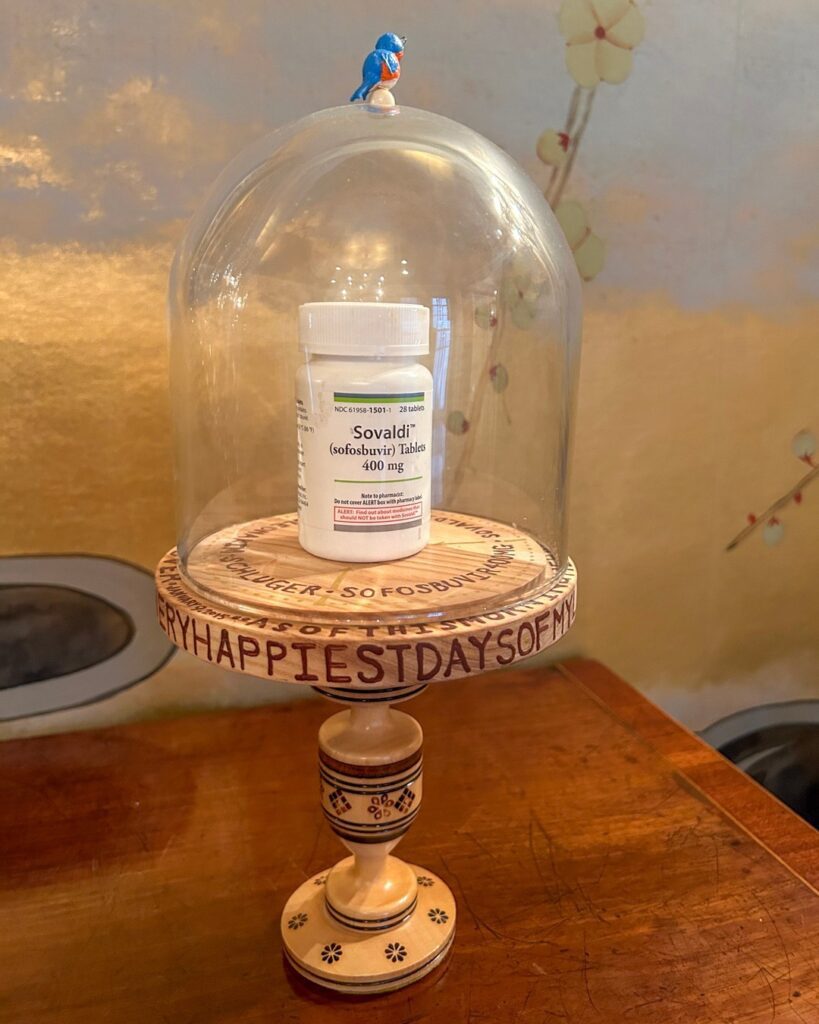
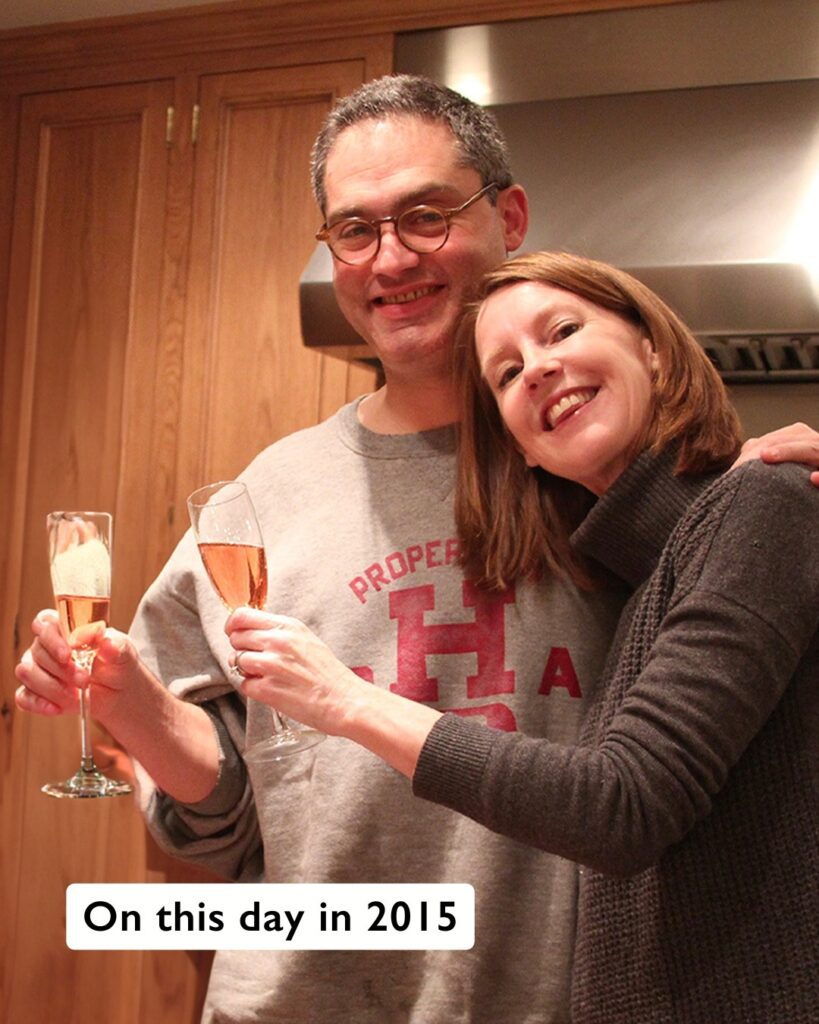
Today marks the eleventh anniversary of the happiest day of my life.
In 2015, in a true miracle of science, my husband Jamie was cured of the hepatitis C he got from a blood transfusion during a childhood heart operation. You really don’t want to have hepatitis C; eventually, it destroys your liver. Jamie tried many treatments over the years, but nothing worked until a new treatment was approved. January 9, 2015, when a test reported that the virus was “not detected,” was the most purely happy day of my life.
Onward,

5 Things Making Me Happy
I’ve never been good at folding sweaters, and I was delighted to learn a new trick that helps folded items stay folded. It’s a whole new approach! And it’s easier than it looks.
Is there a project in your life that’s just…not getting done? Whether you’re feeling frustrated, overwhelmed, or unfocused, my new Audible Original, Get It Done: How to Complete Your Dream Project, can help you push that project across the finish line. In Get It Done, I talk about practical strategies, provide step-by-step worksheets, and share insights from my own life to help you create a personalized plan to stay on track.
I love a good trend piece, and I was very interested to learn that “America is falling out of love with pizza.” Some notable facts: In the United States, pizzerias come third after coffee shops and Mexican food eateries; we hit peak pizzeria in 2019; on any given day, one in 10 Americans eat a pizza slice; young people eat the most pizza. As a low-carb person, I never eat pizza, but my family complains about my habit of sneaking pepperoni off the top whenever an opportunity presents itself.
I love learning a new word, and my walks through the Metropolitan Museum often build my vocabulary. I learned that in art, a roundel is a “small, circular decorative element, often a medallion or a picture/pattern contained within a circle, used in architecture (like niches or windows) or as a component of a larger work.” Now, as I walk through the galleries, I find myself looking for roundels.
My one-word theme for the year is “Neighbor,” and I’m still figuring out how exactly I will incorporate this concept into 2026. It seems to me that an element of neighborliness is holding a belief in the good intentions of others, so I was curious to learn about the current state of social trust. According to the Pew Research Center, in the United States, 55% of adults say most people can be trusted, and 44% say that most people can’t be trusted. In a study of 25 countries, Sweden has the most social trust, with 83% saying that most people can be trusted, with 17% saying they can’t be trusted, while in Turkey, 14% say most people can be trusted, and 84% disagree.

The Easiest Way to Eat Healthier in 2026 Starts on Your Countertop
Grow crunchy, delicious, nutritious sprouts in just 5 days without soil or sunlight. For the new year, get up to TWO Sprouting Kits FREE with our biggest deal of the year ending Jan. 16th. The easiest, healthiest way to start the new year!
This week on Happier with Gretchen Rubin
PODCAST EPISODE: 568
Revealed! Our “26 for 2026” Lists

INTERVIEW
Chris Bailey
Chris Bailey is a bestselling author and lecturer who explores the science behind living a more productive and intentional life. His new book, Intentional: How to Finish What You Start, is available now.
Q: Can you suggest something we might try to help ourselves to become happier, healthier, more productive, or more creative?
I view productivity as a process of becoming more intentional. In this spirit, one of my favorite rituals is to define daily intentions for things I want to get out of each day. I set three intentions, both for work and home, so I can decide precisely how balanced I want to be.
Choosing only three forces you to prioritize what’s truly important—and because you can only choose three, you’ll actually remember them. This is because we think in threes—for example, we have sayings like “good things come in threes” and “the third time is the charm”; we award three Olympic medals, and divide a story into the beginning, middle, and end.
I love the rule not only for becoming more productive but also for becoming more intentional and creative. And because you’ll end up following through more often on what matters most to you, the ritual becomes an unexpectedly large source of daily pride and happiness.
Q: Do you have a Secret of Adulthood? A lesson you’ve learned from life the hard way; something you’d tell your younger self?
If I had to give my younger self one Secret of Adulthood, it would be to look out for the lessons I have to learn repeatedly. There’s almost always something bigger at play there, something I’m missing. For example, for years I’ve been hard on myself for my “bad habit” of ordering delivery food for lunch a couple of times a week. And I’ve repeatedly set a goal to break this habit. But after reflecting on it more, I’ve realized that the problem isn’t the habit: it’s the guilt I have around it. A better goal was to embrace the habit in a way that balances both my pleasure and my health (and, not to mention, my budget). Reflecting deeply on the lessons I have to repeatedly learn always pays dividends. Under the surface, there may be a deeper need we’re not accommodating or a value we’re not recognizing.
A tangential secret: make sure to have rituals that let you tap into your “self-reflective capacity.” This is our ability to look inward, to ask questions of our inner world. Whether that looks like a regular running practice, a meditation ritual, or a journaling habit, do what you can to create space to connect with yourself and your thoughts.
Q: What simple habit boosts your happiness or energy?
Maybe surprisingly, what boosts my happiness and energy the most is approaching my work with a “service mentality”—focusing on how my work might help someone else, not just how I can better serve myself. We live in an individualistic world. But if you’re anything like me, you’re probably more motivated by helping and connecting with others. This focus has probably helped me in my career more than it has hurt. And things become more fun this way, while I do work that I’m more proud of.
Serving others is a much longer-lasting form of motivation than serving only ourselves.
Q: Is there a particular motto that you’ve found very helpful?
Something I’ve repeated to myself for years, and I have no idea where this came from, is the simple phrase “This is the moment.” I find that this simple phrase grounds me. It also reminds me to stay present and get started with stuff. It might just be the meditator in me talking, but I believe the moment is all we will ever really have.
A bonus one, though maybe it’s more of an adage, is “Never attribute to malice that which can be explained by stupidity” (Hanlon’s Razor). Though I’d expand this quote also to include busyness and carelessness. So, the new and improved quote: Never attribute to malice that which can be explained by busyness, carelessness, or stupidity!
Q: Has a book ever changed your life? If so, which one and why?
Books change my life all the time! It’s so hard to pick just one. The one that has changed my life the most is probably Mindfulness in Plain English, by Bhante Henepola Gunaratana. The book may feel hippy-dippy to some, but it is what first got me into meditation. Today, I wouldn’t give up my daily practice for anything. Nothing helps me tap into my self-reflective capacity more.

You signed up to receive this newsletter at gretchenrubin.com