This Sunday, for much of the United States, Daylight Saving Time means the time will shift ahead one hour. I love a good mnemonic, and “Spring forward, fall back” is one of the greatest mnemonics, right up there with “lefty loosey, righty tighty” and holding up my thumb and forefinger to see the “L” for left.

Onward,

5 Things Making Me Happy​

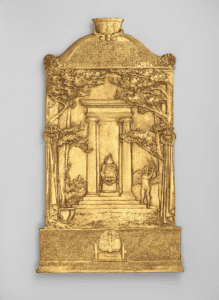
In my daily visits to the Metropolitan Museum, I notice the most random things. I was looking at the beautiful 1913 Cornish Celebration Presentation Plaque and saw that it was presented by Augusta and Augustus Saint-Gaudens (look at the line of text at the bottom). A married couple—with practically the same name? Yes. Like Jack and Jackie Kennedy! That struck me as odd, then I remembered the phenomenon called “implicit egoism”; we’re more likely to trust, like, or partner with people who share our name or initials.

My husband Jamie sent me the short video If Stayin’ Alive had been written in the 16th century. I laughed out loud—and also realized that I love a madrigal! I need to listen to more of this kind of music.

Writing Life in Five Senses made me much more aware of the power of touch—plus Jamie has the Love Language of “physical touch.” I was fascinated by the article, “What being ‘touch starved’ means.” “When touch is wanted and consensual, studies have shown that it can regulate our emotions and benefit our overall well-being.” But these days, many of us aren’t getting enough of this kind of physical connection.

Life in Five Senses also made me more aware of the sense of hearing, and the dangers of noise. Recently I was at a Knicks basketball game, and I was gratified to notice how many babies and toddlers were wearing ear-protection earmuffs—far more than in the past. That’s a great development.

One of the most satisfying aspects of creating my Four Tendencies personality framework was identifying the mysterious, but quite common, pattern of Obliger-rebellion, when an ordinarily reliable Obliger suddenly “snaps” and refuses to meet an expectation—sometimes, quite spectacularly. So many inexplicable incidences became clear when I identified this phenomenon. If you want to know more about it, read here: What is Obliger-rebellion?

SPONSORED BY NORDSTROM

A Spring Wardrobe Refresh

A new season is a good excuse for a small wardrobe reset. Nordstrom’s spring styles include effortless dresses, polished staples, and versatile layers that make everyday outfits feel fresh, comfortable, and easy to wear.

This week on Happier with Gretchen Rubin

PODCAST EPISODE: 576

What Was the Value of Our “No-Spend February?” Plus a Warning About Social-Media Stories

Listen now >

INTERVIEW

Cynthia D’Aprix Sweeney

My friend Cynthia D’Aprix Sweeney is the author of the instant New York Times bestselling novels The Nest and Good Company. Her new book, Lake Effect, is available now. I had a great time at her reading this week at the famous indie bookstore Books Are Magic.

Q: Can you suggest something we might try to help ourselves to become happier, healthier, more productive, or more creative?

Something I think about a lot in the “more creative, more productive” department is expanding the idea of what creative work is to encompass all that we take in and interact with during the process of creation and acknowledging it as work. A book I recommend to writers all the time, especially beginning writers and not only novelists, is Matt Bell’s Refuse to be Done: How to Write and Rewrite a Novel in Three Drafts. I like this book because the three-draft structure is specific and each section not only offers a variety of approaches from established writers but concrete suggestions for what to prioritize in each draft.

He also talks about the “art life” of a book, a concept that resonated with me and one I talk to other writers about all the time. As he puts it: “Every novel I’ve written gradually accrued a project-specific foundation of other art: novels and short stories, poems and plays and essays, movies and music and visual art, all of which somehow felt in conversation with the book I was writing.” Every writer I know has a similar experience and I don’t think we credit building the art life of a project enough as work.

Reading a book that you think might be in conversation with your book is work. Seeing a play, watching a movie, staring at a painting—it all goes into the well that you can draw on when putting words on the page. It’s important to pay attention to your instincts in this area. So many times, in the thick of a novel draft, I’ll have a yen to read a certain book or watch a movie or listen to a piece of music (over and over and over) and although I can’t identify why in the moment, following that instinct always pays off in some way on the page. It might be in a way that only I can recognize, but it’s there. We tend to think of these forays into art as indulgences or, even worse, procrastination. But it’s work! It deserves the same respect as your word count for the day (as long as you’re keeping yourself honest). I try to do what I think of as directed reading during the workday when the writing is not coming. What can I delve into to get my brain whirring again? Words on the page count, of course, but so does all the ways we fill the tank off the page.

Q: Do you have a Secret of Adulthood? A lesson you’ve learned from life the hard way; something you’d tell your younger self?

You know what you want; stop trying to talk yourself out of it.

Q: What simple habit boosts your happiness or energy?

A long walk is my favorite way to quell anxiety, solve a problem, get out of my head, acquire perspective. And seeing friends, especially the people I’ve known a long time. Knowing various versions of another human and having them know you is a real gift.

Q: Is there a particular motto that you’ve found very helpful?

Some years ago, a quote by Ira Glass was making the rounds. When I read it, I wished someone had said something like this to me when I was much younger. It might not have taken me so long to publish my first book! It’s the smartest thing on starting a creative practice that I’ve ever read. The most hopeful, too! I present it to you here, slightly edited:

“Nobody tells this to people who are beginners, I wish someone told me. All of us who do creative work, we get into it because we have good taste. But there is this gap. For the first couple years you make stuff, it’s just not that good. It’s trying to be good, it has potential, but it’s not. But your taste, the thing that got you into the game, is still killer. And your taste is why your work disappoints you. A lot of people never get past this phase, they quit. Most people I know who do interesting, creative work went through years of this. We know our work doesn’t have this special thing that we want it to have. We all go through this. And if you are just starting out or still in this phase, you must know its normal and the most important thing you can do is do a lot of work. It is only by going through a volume of work that you will close that gap, and your work will be as good as your ambitions. And I took longer to figure out how to do this than anyone I’ve ever met. It’s going take a while. It’s normal to take a while. You have to fight your way through.” 

—Ira Glass

Listen to the Happier podcast?
Click here to read the show notes.

You signed up to receive this newsletter at gretchenrubin.com

{{ organization.name }} {{ organization.full_address }}

Subscribe to Gretchen’s newsletter.

Every Friday, Gretchen Rubin shares 5 things that are making her happier, asks readers and listeners questions, and includes exclusive updates and behind-the-scenes material. 

;